


If you plan to only rely on Social Security benefits for financial support, you will most likely not be able to enjoy the retirement lifestyle you hope for. Understanding how Social Security benefits work and what benefits you can expect to receive may be a big wake-up call.
The Savings Gap
Social Security was never intended to be the sole source of income for retirees. While Social Security replaces about 43% of the medium earner's pre-retirement earnings, most financial advisors say that you will need 70% or more of pre-retirement earnings to live comfortably.1 You will need to make up the other 30% of pre-retirement income from other sources like a state pension plan or personal savings.
Because of this, estimating Social Security benefits is vital to your retirement planning process. It’s also important to understand that the saving estimate doesn’t necessarily consider every retiree’s plans—expectations and lifestyles can vary significantly from one retiree to another. Setting retirement lifestyle goals early and estimating the cost of this lifestyle is vital to successful financial planning.
Retirement Age
Some may not realize their monthly Social Security benefit amount is also dependent on retirement age and the year they're born.
If you were born after 1960, Social Security Retirement Age (SSNRA) is 67. At 67, you can receive 100% of your Social Security benefits. However, if you decide to retire early, your benefits may be significantly reduced. Retiring at 62 instead of 67 could mean you only receive 70% of your Social Security benefit. If you decide to wait until after your Social Security retirement age, you can actually receive more per year until age 70, up to 124% of benefits.2
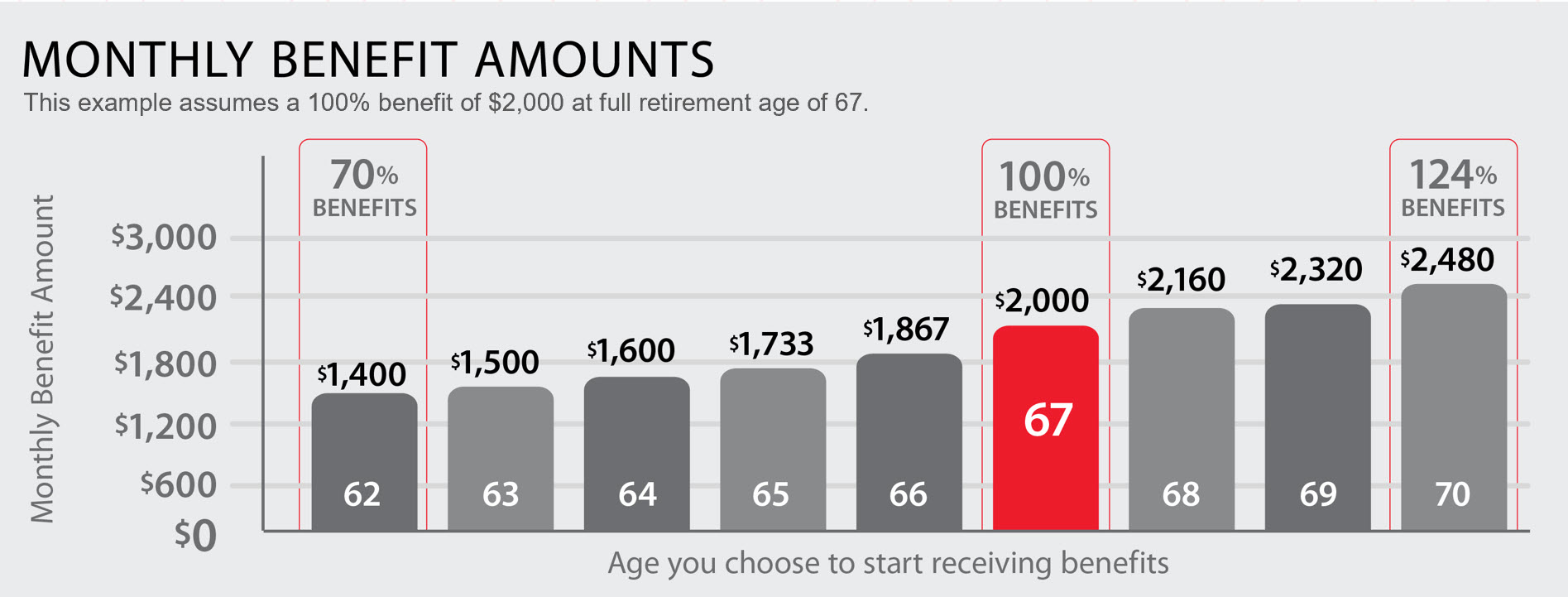
It’s also important to understand that there are Social Security benefit maximums, regardless of contributions. For an individual retiring at full retirement age in 2025, the Social Security earnings limit is $62,160.3
Social Security Taxation
Another misconception about Social Security benefits is that they are never taxed. Single filers with a combined income between $25,000 and $34,000 may have to pay taxes on up to 50% of their Social Security benefits. If combined income is over $34,000, they may pay taxes on up to 85% of their Social Security benefits.4 Married couples filing jointly may pay taxes on up to 50% of their Social Security income if they have a combined income of $32,000 to $44,000. If they have a combined income of more than $44,000, they can expect to pay taxes on up to 85% of their Social Security benefits.5 This should be taken into consideration when estimating retirement income savings goals.
Estimating Benefits and Savings Needs
The Social Security Administration offers a free calculator to help you estimate your monthly benefit amount based on your income, age, and retirement age. Knowing your monthly benefit amount will help you estimate what you need to save outside of Social Security benefits.
This blog is up to date as of December 2025 and has not been updated for changes in the law, administration or current events.